Introduction
Mr. Abubakar Khalid Sentongwa from Uganda recounts the story of applying FIRSTedu-ADLX Framework and the impact this application had. He serves as an education supervisor and Head of the Arabic Language Department at the Nakasa Center. Born in 1993 in Magonga Village in the Mukono–Kampala area, he progressed through various educational stages and specialized in Arabic at Makerere University. He is experienced in facilitating Islamic sciences and the Arabic language in local Islamic institutions. He experienced the FIRSTedu-ADLX framework through a developmental learning journey and sensed the transformation it brought to his thinking and practices.
The Challenge or Problem
Before experiencing the FIRSTedu-ADLX framework, Mr. Abubakar relied solely on lecturing and direct instruction, giving learners no opportunity to participate. This weakened interaction and reduced the impact that the learning journeys left on the learners.
Learner Persona
In Mr. Abubakar’s learning journey involved boys aged 14–18 studying at Nakasa Center for Education and Arabic Language. All were males, with a total of 25 learners. Their main challenge was the belief that charity wastes money and that giving is restricted to the wealthy. They lacked guidance on the virtue of charity and had no idea that charity need not be monetary (money). They needed to understand the higher purpose of giving and wished to learn about different forms of charity beyond money.
Learner Persona Details:
- Feels:
- That anyone who gives from his wealth is wasting it and gains no benefit.
- Hears:
- People saying that mosque imams and others consume charities rather than giving them to the needy.
- Sees:
- Some Muslims refraining from spending their wealth.
- Thinks:
- That the poor should not give anything at all, even a little; charity is only for the rich.
- Does:
- Never gives charity, not even a small amount.
- Says:
- “I don’t have a job, so how can I give charity?”
- “Giving must be in cash.”
Main Challenges:
- They had no guide to teach them the virtue of charity or that charity is not limited to money.
- They believed that spending is a waste of wealth.
Key Needs and Desires:
- They needed to understand the greater purpose of giving.
- They wanted to learn about forms of charity other than money.
Overview of the Learning Journey Design
Why FIRSTedu-ADLX?
Because it offers facilitators structured, interactive, and active methodology centered on the learner and helps the learners live an Active Deep Learner eXperience, Mr. Abubakar chose FIRSTedu-ADLX Framework.
Learning Outcomes
Attitude:
- To appreciate the virtue of charity.
- To sense the danger of neglecting it.
Skills:
- To explain the meaning of the hadith in their own language.
- To address people and teach them the meaning of the hadith.
Knowledge:
- To memorize a hadith about charity.
- To identify the narrator of the hadith.
Parallel Outcomes:
- Attitude: To feel compassion toward the needy.
- Skills: To deliver a confident speech and collaborate with peers.
Performance Outcomes:
- To apply various forms of charity in daily life.
- To cite verses and hadiths encouraging charity.
- To initiate giving when needed.
Design Summary
The learning journey addressed a hadith in which the Prophet ﷺ explained that charity extinguishes sin just as water extinguishes fire. The facilitator clarified that sins are like firewood touched by flames—fire corrupts everything it touches, and similarly, sins corrupt the soul and distance it from Allah, leading eventually to the fire of Hell. He drew from them the lesson that sins are erased by charity, along with other means. When a person’s sins are erased, Allah loves him, and he enters Paradise.
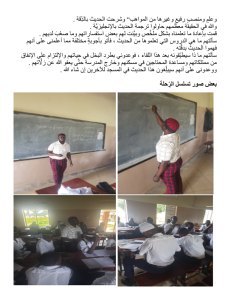
Before the one-hour session, Mr. Abubakar prepared various learning materials (matches, old papers, a water container). He entered carrying the materials, asked about the learners’ well-being and absentees, and then asked them about the learning materials and their names. He explained the purpose of each item and wrote on the board: “The Importance of Charity.”
He then arranged the learners into four groups to exchange ideas about the importance of charity and good deeds (cooperative learning). As he walked between the groups, he encouraged expression of ideas and participation. A representative from each group later presented the group’s thoughts, and Mr. Abubakar listened attentively and commented briefly on each one.
This learning activity was followed by a mini-presentation explaining the hadith, energizer, another learning activity (Fire and Firewood), a linking and summarizing activity, and a closing activity.
The facilitator used the RAR model in designing the learning activities as clarified in the activity that follow.
Learning Activity Using the RAR Model: Fire and Firewood
- Readiness Increase:
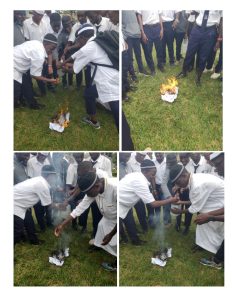
The facilitator presented learning tools such as the bucket, matches, and papers, eliciting their names and uses from the learners. He then invited a volunteer to light the fire. This step motivated the learners, heightened their enthusiasm, and prepared them for a practical activity representing a prophetic hadith.
- Activity Facilitation:
A volunteer lit the papers. Once they ignited, the facilitator invited learners to pour water to extinguish the fire. Throughout the activity, he monitored engagement and asked questions such as:
- What do you notice?
- What is happening?
- What does the fire represent?
- What does the water do?
- Reviewing Actively:
After completing the activity, the facilitator asked:
- “How did you feel when you saw the fire go out?”
- “How did you connect this to the hadith?”
- “Why does charity extinguish sin?”
He then invited them to relate the scene to their daily lives and consider what they would do in real situations requiring charity.
FIRSTedu-ADLX Framework Domains
- F-Domain:
The facilitator applied this domain by:
- Allowing every learner to participate practically and cognitively, inviting them to read and explain, making each feel central to the learning.
- Checking understanding through repeated questions before, during, and after the activity, and monitoring practical application.
- Assigning leadership roles and inviting learners to carry out tasks independently.
- Listening attentively to their ideas and future plans.
- I-Domain:
This was achieved by:
- Designing the journey as a social event through cooperative learning and collaborative activities.
- Maintaining a positive spirit through encouraging words like “Excellent!” and “Well done!”
- Sustaining motivation and attention through varied activities (images, videos, hands-on materials, reading).
- R-Domain:
The facilitator applied the RAR model throughout all learning activities, as demonstrated in the firewood-and-fire activity, reinforcing deep learning and real-world connection.
- S-Domain:
The facilitator arranged the activities logically according to the type and level of energy required (mental, physical, emotional):
- Opening Activity – Preparation (10 min): Greetings and check-in.
- Charity – Discussion (15 min): Group discussion on the importance of charity.
- Mini Presentation – (5 min): Video, images, and explanation of the hadith.
- Energizer Activity – (5 min).
- Learning Activity: Fire and Firewood – Practical Application (15 min): Lighting and extinguishing the fire; practical explanation of the hadith.
- Linking and Summarizing – (5 min): Summarizing benefits and clarifying other means of erasing sins.
- Closing Activity – (5 min): What will they do after the session?
- T-Domain
This domain was strengthened by conducting a live demonstration of the hadith’s meaning and later applying it by giving one learner some money and observing what he did with it, reflecting the practical impact of charity. Students also committed to sharing the hadith with others and applying what they learned.
Conclusion and Reflection
Impact on Learners:
The learners demonstrated unprecedented enthusiasm and engaged sincerely in the activities. They said that this learning method made understanding and application easier and helped them appreciate the value of what they learned.
Impact on the Facilitator:
The facilitator realized his role is to guide and facilitate, not merely lecture. He observed that deep learning is only achieved through real-life practice and became more convinced of the importance of giving learners opportunities to explore and discover.
Impact on the Community:
Although the direct impact is still emerging, some learners shared the hadith at the mosque and encouraged others to give charity.
Application Photos:
Photos were taken during the fire-lighting and extinguishing activity, documenting the learners’ engagement and participation.

✍️ By: Mr. Abubakar Khalid Ssentongwa – Uganda
And Allah grants success.