About the Facilitator
Abeer Ardat – from Beirut, Lebanon, holds a Bachelor’s degree in Psychology and a Diploma in Education. She has spent 30 years in the field of early childhood education, starting as a teacher and progressing to the positions of coordinator and educational supervisor. Currently, she teaches early childhood education and psychology to vocational baccalaureate students specializing in early childhood education.
As for the learning journey, the facilitator applied FIRST-ADLX Framework in a 12-hour training program spread over five days. The program targeted fourteen women aged between 18 and 25 years old from diverse educational backgrounds who didn’t know each other. The aim of the program was to qualify them to work as “assistant caregivers”.
Introduction to the Application Story
The caregiver must be knowledgeable about the characteristics of the children’s different age groups. This helps her understand their behavior, explain it scientifically, and respond appropriately to the current situation with the aim of modifying the child’s behavior and preparing him to be a successful and effective member of society. Based on this belief, I designed and facilitated a learning journey that addresses “child development from birth to three years.” The learning outcomes were designed as follows:
Learning Outcomes
Main Learning Outcomes
By the end of this journey, the learner will be able to:
Attitude Outcomes:
- Accept and tolerate children’s behavior.
- Appreciate the role of the caregiver and understand its importance.
- Recognize the necessity of emulating the successful caregiver’s morals and high values, as she serves as a role model for children.
Skills Outcomes:
- Communicate effectively with children.
- Communicate effectively with colleagues in the nursery and with parents.
- Modify children’s behavior in the nursery using positive parenting principles.
- Use various activities suitable for different areas of development.
Knowledge Outcomes:
- List the characteristics of different age groups.
- Identify the factors that influence children’s development.
- Define the principles of positive parenting.
Parallel Learning Outcomes
In this life, the successful individual is the Muslim who adheres to the teachings of their religion and is prepared to lead nations. Therefore, this journey included highlighting verses, hadiths, and the actions of the pious predecessors that align with the topic of the journey to achieve the following parallel outcomes:
- The learner should value the Islamic values that we seek to instill in children.
- The learner should know some verses and hadiths related to the topic of the journey.
- The learner should list some of the actions of the pious related to the topic.
Performance Outcomes
- The learners should be able to understand the behavior of nursery children and work to modify it according to the principles of positive parenting.
More About the Implementation Story
The main title was “Child Development Psychology,” and the following topics were covered:
- Child development psychology and its benefits
- The stages of child development and the factors that influence them
- The most common problems at this age
- The fundamentals of positive parenting
- The tasks of an assistant caregiver and the importance of their role
Over 12 hours spread over 5 days, we experienced the realm of child development psychology through an Active Deep Learner eXperience designed and facilitated with FIRST-ADLX Framework.
Applying the Domains and Principles of FIRST-ADLX Framework
1- Focusing on the Learner Behavior
Throughout this journey, I carefully applied the FIRSTedu-ADLX framework at all stages:
(Individualization- Probing and Assessing-Trust the Learner)
- From the first day, participants were introduced (names and adjectives describing them), and an activity was conducted where participants had to read the adjectives that described other participants and guess who possessed them.
- One participant was asked to create a WhatsApp group, and daily communication and educational videos were shared.
- Monitoring groups during activities and providing feedback on discussions and group presentations served to verify and assess learning.
- Group and pair work, as well as individual presentations and participation, helped build the students’ self-confidence and demonstrated the facilitator’s trust in them.
2- Interacting within Positive Group Dynamics
(Social Event – Positive Spirit – Attention and Motivation)
- I made sure to foster a positive atmosphere among the students, leading to the development of friendships between them.
- I maintained a positive spirit, which helped build a positive relationship between the students and the facilitator.
- All verbal and written contributions were characterized by positivity and positive interaction.
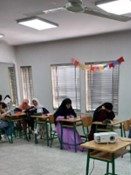
- Group formations were diversified, and seating arrangements were changed multiple times (in a train formation, standing in a circle, large groups, pairs).
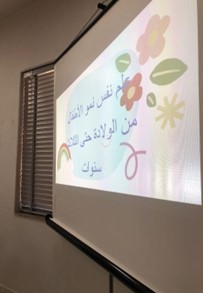
- Presentation methods were varied, including interactive PowerPoint presentations involving students, short educational films, films about children in nurseries, and sharing previous experiences with children to maintain focus, attention, and motivation.
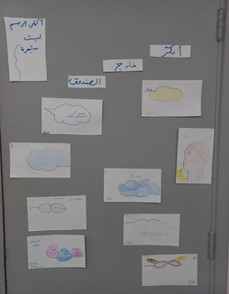
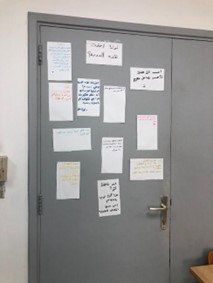
- Decorating the classroom and hallway with students’ work had a positive impact (a significant motivating factor).
3- Reviewing Activities within RAR Model
(Readiness Increase- Activity Facilitation- Reviewing Actively)
I applied the RAR model in all learning activities. As an example, let’s consider the following activity:
The Areas of Growth and their Characteristics
- Readiness Increase: After ensuring that the learners were psychologically ready and prepared to start the activity, I provided them with instructions (mental readiness): sitting in a train formation (physical readiness), writing the name of an area with a pencil, then passing the paper to the classmate sitting behind them who would write the characteristics of that area with a colored pen they had previously chosen. This process continued until all papers were completed, with each paper including all areas and their characteristics.
- Activity Facilitation: I monitored the learners, moving among them, sharing ideas, and coordinating the pace of passing the papers to ensure a continuous flow. We also had brief discussions to clarify, verify, and assess.
Upon completion, the participants exchanged papers, and each student retrieved their original paper and pasted it in their journey notebook (the paper size was adjusted to fit the notebooks for future reference).
- Reviewing Actively: I pulled all the areas of growth and the importance of nurturing them in children. I then asked about the benefit of this activity. The comments were (in Lebanese dialect): “Now we understand why they behave like that. It turns out that this work is well-thought-out and not random. It turns out that raising children requires seriousness.” This indicates a change in the participants’ mindset and their ability to connect what they learnt to reality and children’s behavior. It also highlighted their readiness to modify their behavior with children and the practical steps to do so.
4- Sequencing within the Session Flow
(Structuring and Sequencing- Repetition without Boredom- Linking and Summarizing)
- We ensured a balance between pulling and pushing (brainstorming, sharing previous experiences with children, individual and group discussions, presentations in front of the entire group…) to avoid boredom.
- Presentation methods varied between PowerPoint, video clips of children and short educational films, and distributing printed materials… respecting different learning styles and the energy level required for each activity.
- We began with a pre-opening activity, followed by an activity to connect and summarize the information from the previous day in different ways. (A competition between two groups with a designated judge and recording results while avoiding negative competition, expressing the previous concept through drawing…)
- The participants were informed about the topic of the next meeting and were excited about it.
5- Transforming Learning into Performance
(Reflection on Reality- Practicing and eXperiencing- Continuity and Follow up)
- Participants contributed examples and explained why a child might engage in a particular behavior.
- Participants contributed examples and discussed the appropriate response to a behavioral issue. (Real-Life Scenarios)
- Role-playing activities (child and caregiver).
- The participants visited a nursery at the end of the theoretical part to apply what they have learned during the learning journey.
Impact of Implementing the FIRSTedu-ADLX Framework on the Facilitator:
This experience has impacted my performance as a facilitator in the following ways:
- The sequential connection between activities made my journey as a facilitator smoother.
- I also focused on reviewing actively according to the RAR model.
- The topics we covered over the five days were linked together.
- I reactivated training strategies and methods that I sometimes used, but now they are more organized within FIRST-ADLX framework.
- I gave names to the activities I do, making them more ingrained in my mind and encouraging me to adhere to and apply them.
- I liked the focus on the learner, their psychology, emotional state, and their ability to comprehend during the learning journey.
- I encourage teachers and trainers to attend this training and apply it in their teaching, especially Islamic education teachers or teachers of various subjects in Islamic schools. We must invest in all modern studies and active strategies for the benefit of building a balanced Islamic personality.
- After attending the FIRSTedu-ADLX learning journey and applying the framework in my work, I intend to follow these steps in all future learning journeys, God willing.
Impact on the Learners:
The impact was also evident on the learners:
- A strong bond of trust was built between the facilitator and the learners, to the extent that they told me about some problems they had in other classes.
- On one of the days, I told them, “Be prepared for tomorrow because we have 4 sessions, bring some painkillers,” and they replied, “I wish every day was with you,” “Nothing hurts my head when I’m with you.”
- When we started communicating on the WhatsApp group, I felt that the conversations had become too personal between girls of the same age, so I suggested leaving the group and creating another group that would be more professional. Their response was to keep me in the group if I wasn’t bothered by their long conversations.
- At the end of the learning journey, I intend to create another group that is more professional and educational to follow up with them on their professional journey if they need any advice or assistance.
- Information was reinforced through repetition without boredom, reviewing actively, and other principles. Everyone was encouraged to participate and express their opinions freely.
In conclusion, I share with you some photos from the journey we took…