About the Writer:
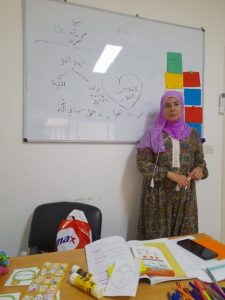
Mervat Shaaban Abu Zeid is an educator and trainer from Lebanon, specifically from the city of Beirut. She holds a Diploma in Islamic Studies and is in the process of preparing a master’s thesis entitled “Developing the Skills of Young People inspired by the Prophet’s Guidance.” She has extensive experience in the field of audio engineering, spanning more than twenty years, before transitioning to the field of religious education. She has worked in religious courses for young people in several sessions and currently works as an Islamic education teacher at Al-Makassed Islamic Schools.
Ms. Mervat shares with us the story of her application of the FIRST framework in a learning journey entitled “Sincerity in Work,” which she presents to the teachers of the Al-Majidiya course. This journey targets a group of female teachers ranging in age from twenty to forty, totaling nine teachers.
Introduction to the Implementation Story:
The learning journey that I facilitated is considered one of the important learning journeys for teachers in my workplace because of the meanings and concepts it carries about sincerity in the course of work. Sincerity is considered the cornerstone in building, building the character of a sound, righteous, and reforming Muslim child. The teacher-facilitator is a role model for children, so if her work is sincere for Allah, this is reflected in the nature of the work, and she becomes a role model for her students and instills in them sincerity for Allah, in work, and in all matters of the world. I was chosen for this task because of its importance, so I designed a two-hour learning session that includes a variety of activities, and I took into account in its design and facilitation the FIRSTedu-ADLX framework, as I applied the domains of the framework in the overall journey, that is, outside the synchronous session as well.
Learning Outcomes:
By the end of this journey, the learner will be able to:
Attitude Outcomes:
- Feel the value of sincerity and work together.
- Appreciate the importance of the work they do.
Skills Outcomes:
- Apply sincerity in their work.
- Define and organize their work.
Knowledge Outcomes:
- Define sincerity in work.
Performance Outcomes:
- To be sincere in religious educational work.
- To instill sincerity in the child’s personality to make them a righteous child, sincere in their work and community, on both religious and worldly levels.
Activity Sequence:
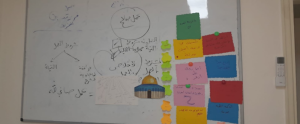
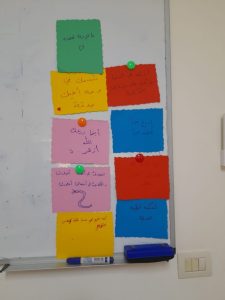
- We started the learning meeting at 4:30 PM with an opening activity where I invited the learners to write their favorite quote on a colored card and place it on the board. Then, I encouraged the learners to stand in front of everyone and talk about the quote and its importance in their lives. After that, we started drawing a heart on the board and asking questions about the symbolism of this heart. In this mini-presentation, I was keen to balance the processes of pulling and pushing and give the learners the opportunity to participate before explaining the meaning of the title.
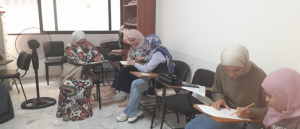
- Afterwards, I divided the learners into groups, and each group contemplated an image and projected it onto the topic of the meeting. Then, we discussed sincerity in work and its importance in religious courses. I followed this learning activity with an energizer where I distributed sticky notes to the trainees, and they wrote the first letter of their name with a positive attribute and posted it on the board so that we could read it and talk about it in a friendly atmosphere and a lot of fun.
- Then, we did a linking and summarizing activity (right or wrong), during which I conducted a probing and assessing process. As for the closing activity, we drew a mind map of the session topic. Then, we applied the idea of good deeds and distributed gifts, encouragement cards, exit and follow-up cards, and we also agreed to organize a group breakfast.
Applying the Domains and Principles of FIRSTedu-ADLX Framework:
Throughout this meeting, I was keen to apply the FIRSTedu-ADLX framework at all stages. I share with you some examples that fall under each of the domains and principles for illustrative purposes, not exclusivity.
1) Focusing on the Learner Behaviors:
(Individualization – Probing and Assessing – Trust the Learner)
Individualization:
This principle was achieved through:
- Drawing a heart on the board and using the pull and push method with a balance between them, ensuring the participation of all learners without exception, and giving each of them the space to connect the heart drawing to their feelings and personal reality (Note: the goal was that sincerity is intention, and the intention resides in the heart).
Probing and Assessing:
This principle was achieved through:
- The process of extracting the definition of “sincerity” linguistically and idiomatically, and “work” linguistically and idiomatically, and the nature of their role in religious courses.
- The process of following up and intervening in group work, as the learners were divided into three groups and images were distributed to identify the differences between the images. I ensured their conclusion of a title for the image, such as “chaos” or something similar in meaning, and I also ensured their discussion of what chaos leads to in work and their conclusion that organization in the course of work is required, even at the level of religious courses.
Trust the Learner:
This principle was achieved through:
- Giving the learners the role of the teacher and inviting them to lead and facilitate some of the activities for their colleagues, as we did, for example, in the activity “Infer from the image the importance of organization and sincerity in religious courses.”
2) Interacting within Positive Group Dynamics
(Social Event – Positive Spirit – Motivation and Attention)
Social Event:
This principle was achieved through:
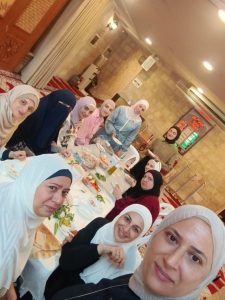
- Ensuring that the session was like a gathering among friends, to the extent that we agreed among ourselves on a group breakfast meeting to increase familiarity and affection among the teachers, and this took place a few days after the course.
Positive Spirit:
This was achieved through:
- Dealing with kindness and the cheerful spirit that was fostered among the learners.
- Ensuring that all answers were accepted.
- Receiving errors with absolute positivity and turning them into learning opportunities.
- Distributing and exchanging symbolic gifts at the end of the course.
- Joking with the learners.
Motivation and Attention:
This principle was achieved through:
- Diversifying activities and providing continuous encouragement to complete tasks.
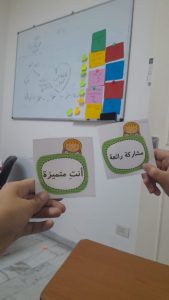
- Distributing encouragement cards to the learners and praising them with motivating phrases.
3) Reviewing Activities within RAR Model:
This domain was achieved through:
- Readiness Increase:
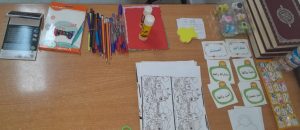
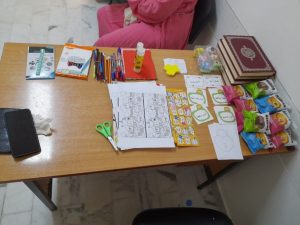
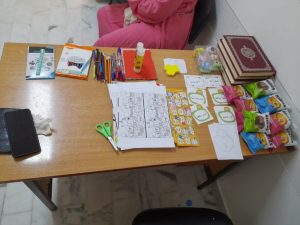
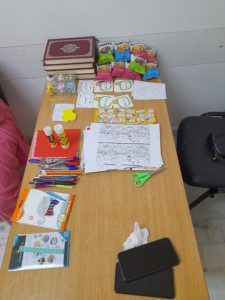
- I prepared the learners mentally, physically, and psychologically for each of the activities. I put questions on the board about the meeting topic, divided the learners into three groups, distributed the tools (paper – pen), drew circles on the papers with the words “good deed” written in them, and motivated the learners to start the activities.
- Activity Facilitation:
- I maintained the learners’ attention, enthusiasm, and focus during the activities by asking them questions: “What is the meaning of this circle?” “What task do you plan to do to perform a good deed that benefits society, with sincere intention?”
- I also followed up with the learners, probed, assessed, encouraged them and ensured everyone’s participation.
- Reviewing Actively
- After the activity facilitation stage, I invited the learners to reflect on the activities and share future practical steps they intend to take based on them.
4) Sequencing within the Session Flow:
- During the meeting, I did the following:
- Structuring and Sequencing:
- Dividing the content from easy to difficult.
- Choosing activities that suit the learners.
- Diversifying the activities and arranging them in a way that suits the level of energy they require (using images as visual aids, such as an image of Al-Aqsa Mosque and linking it to their sincerity in defending their land, and that the only motivation is sincerity to God and then to the homeland, and drawing a heart on the board to draw the learners’ attention and link it to sincerity, because sincerity is intention, and the intention resides in the heart).
- Repetition without Boredom:
- I repeated the basic concepts and key words in various ways and different activities, and I also invited the learners to repeat them.
- Linking and Summarizing:
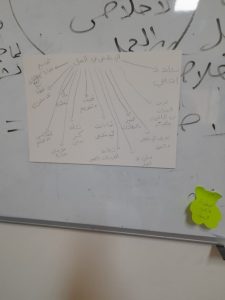
- Linking and summarizing through the pre-closing activity (true or false) and the closing activity, where the learners drew a mind map on the board that they designed themselves.
5) Transforming Learning into Performance:
(Reflection on Reality – Practicing and eXperiencing – Continuity and Follow-up)
This domain was applied through:
- Reflection on Reality:
- Projecting the session topic onto the Al-Majidiya learning journey and how the topic of sincerity in work affects the workflow during this particular journey, and the extent of its importance and impact on teachers and then on students.
- Asking questions about the importance of this topic during religious learning journeys.
- Sharing the learners’ real-world experiences in this field.
- Continuity and Follow-up:
- Extracting future steps: What next?
- Developing a future plan to organize the workflow in upcoming learning journeys. In conclusion, it was agreed to follow up on the plans that were developed and implement them in the next course, and then to schedule another meeting to follow up and keep pace with the topics that are of interest to teachers in religious courses to build a sound, righteous, reforming, and successful child in their community.
Impact of Applying FIRSTedu-ADLX Framework:
On the Facilitator:
- Developing a solid plan to apply the FIRSTedu-ADLX framework in the learning journey facilitated the achievement of the learning outcomes by the learners.
- After the learning journey, I felt happy with what I designed and facilitated and with all the various ideas and activities that I experienced with my learners.
- The framework facilitated the facilitator’s work in terms of mini-presentations, activities, and ideas derived from it.
- I got to apply a unique and flexible facilitation framework, which made the session enjoyable for the learner and made them look forward to other sessions.
- The vision I came away with is that people naturally tend to like distinctive things, and the FIRSTedu-ADLX framework is distinctive in every sense of the word.
On the Learners:
- During the session, the learners were engaged and enthusiastic about the new methods and various activities that the session involved, and they did not feel bored. The topics were experienced in new ways that attracted them and grabbed their attention.
- After the session and the journey as a whole, the learners asked for some other meetings.
On the School or Community:
- Inshallah, there will be a deep impact on religious learning journeys when the FIRSTedu framework is applied, but the session was currently limited to the teachers. May what the learners experienced be applied, and we see its impact in future journeys.
At the end, I’d like to thank FIRST Academy for all it has provided in terms of developing the facilitation process, the facilitator’s work, diversifying activities, and creative ideas, leaving an impact and a mark on our journey, which made the teaching process extremely enjoyable. May we have conveyed this spirit through our facilitation of the learning journey that we shared with you. May Allah, make us our work accepted.
I share with you some pictures of the journey we lived…