About the Facilitator
Ms. Najlaa Sameer Amin Ibrahim, from the city of Cairo, holds a Bachelor’s degree in Kindergarten Education from Cairo University. Furthermore, she has enriched her educational journey with numerous courses in the field of Islamic Studies, which include Al-Mahawer Academy, Al-Benaa Al-Manhaji Academy (Systematic Construction Academy), Taj Al-Karama (Crown of Dignity), Mudakker (Reminder), courses in acquiring sciences that aid in understanding the Revelation, courses from Al-Fath Center for Research and Studies, Ayat Academy for Islamic Sciences, the Living with the Quran program, and a study of the heritage of Ibn al-Qayyim. She also holds an Ijaza (certification) in the recitation of the Quran according to the narration of Asim. On a practical level, she works as a coordinator at the International Relief Institute, one of the organizers of education at the Jiwar Charity Foundation, and is also a Quran memorization teacher at Ahl Al-Quran Academy and Mawten Al-Uns Academy.
Introduction
This learning journey aims to build the learners’ character and enhance their self-confidence, noting that the learners were girls aged between 14 and 16 years, specifically girls in the late intermediate and early secondary stages, i.e., in adolescence, distributed across two levels. The first level has already been implemented with a group of ten learners through four synchronous and four asynchronous meetings, during which they participated in a variety of activities, interactions, and assignments, and acquired skills to help them overcome some of the difficulties and challenges they face at this important age. In this story, we share aspects of the design and facilitation process of this journey as an Active Deep Learner eXperience inspired by FIRST-ADLX Framework, with the aim of transforming their experience into an impactful one.

Learning Outcomes
Main Learning Outcomes: At the end of this journey, each learner will be able to:
Attitude Outcomes:
- Trust herself
- Appreciate the importance of self-confidence
Skill Outcomes:
- Deal with challenges confidently
- Plan for the future confidently
Knowledge Outcomes:
- Know the concept of self-confidence
Parallel Learning Outcomes
Attitude Outcomes:
- Appreciate the value of time and organization
- Feel psychological safety
Skill Outcomes:
- Interact positively with her peers and the facilitator
- Develop critical analysis skills and the etiquette of discussion
Knowledge Outcomes:
- List the steps of critical analysis and the steps followed in analyzing personalities
Performance Outcomes
- Avoid arrogance and differentiate between it and confidence
- Deal confidently in her daily life, whether in dealing with challenges, daily tasks, or others
- Help others to trust themselves

Application Story
Based on my experience in my journey with FIRST, I began designing an Active Deep Learner eXperience that suits the learners’ personas and addresses the challenges they face. I observed that anxiety about self-image and how others evaluate them was a prominent concern, which could lead some of them to silence or exaggerated reactions. Therefore, I ensured that the experience was inspiring by presenting motivational videos and stories that stimulate discussion and reflection. I also strived to make it interactive by encouraging the acceptance and discussion of mistakes (presenting inspiring videos or stories, discussing and commenting on them), and transforming the view of mistakes from an obstacle to a learning opportunity by sharing previous negative experiences and how to deal with them. I also sought to make the experience supportive by creating a safe and encouraging environment. I did not overlook the importance of developing critical thinking by encouraging students to critique themselves, express their viewpoints, and accept the opinions of others without ridicule or condescension. In addition, I encouraged reverse thinking through a role-playing activity that prompts them to think about how to act confidently in past situations where they felt a lack of confidence. I worked to make the experience self-enhancing by promoting participation and discussion, and by having students create achievement boards and discuss the role of these achievements in building their self-confidence. I also encouraged self-expression and effective communication, and promoted group interaction by

encouraging them to present their opinions and exchange them effectively in various situations.
Applying the Domains and Principles of FIRSTedu-ADLX Framework
Throughout this meeting, I was keen to apply FIRSTedu-ADLX framework in all its stages:
1) Focusing on the Learner Behavior
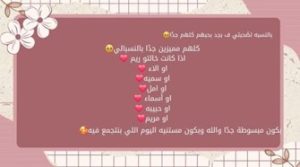
From the very first moment of our meeting, I ensured that each girl felt she was the center of my attention, care, and support. This went beyond simply memorizing their names to include addressing each one with a unique name derived from her own, carrying a deeper meaning and positive aspirations that we hope will accompany them throughout their lives. Even for those whose names did not directly carry an inspiring quality, I made an effort to choose a nickname that reflected apparent positive traits. I also paid close attention to listening to them with my eyes and full concentration as they spoke, repeating what they said if it was correct or asking for further clarification to ensure understanding. I opened the floor for them to express their opinions with complete freedom, while emphasizing mutual respect among everyone. I did not hesitate to provide opportunities to ask questions and utilize them as a tool for verification and evaluation, and to encourage them to talk about their feelings. Furthermore, I was keen to ask more questions that would drive the discussion to serve the learning objectives, and I granted them trust and the opportunity to design activities they preferred themselves.

2) Interacting within Positive Group Dynamics
After laying the initial foundations of trust and individual communication between myself and each girl (the first domain), it was essential to build solid foundations for positive interaction among them (the second domain). In addition to encouraging the free expression of opinion, I was keen to provide opportunities to accept the opinions of others without requiring their adoption or necessary agreement. I also carefully distributed roles and responsibilities among them, emphasizing the integration and interdependence of these tasks, so that the work of one was built upon the accomplishment of another. I ensured that the girls were assigned interactive pair work to complete tasks in a team spirit. I divided the learners into groups according to their similar patterns at times to foster a sense of sisterhood and unselfishness, and according to their preferences at other times to promote cooperation and the exchange of experiences. I also emphasized the importance of positive and constructive feedback, and varied the methods of motivation between intrinsic and extrinsic motivation. I also used the method of role-playing in a way that suited their needs. Finally, I employed the power of storytelling, whether from their own experiences or from what they read or watched, as a tool to enhance communication and interaction.

3) Reviewing Activities within RAR Model
Now is the time to share the opening activity and one of the learning activities, where we applied the RAR model.
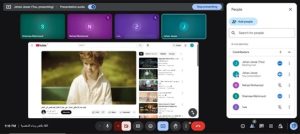
Opening Activity: The Short Film (20 minutes)
In the “Readiness Increase” stage, I captured the learners’ attention by saying: “Now we will focus together – God willing, today we will show a short film lasting three minutes – the film presents the experience of two boys, and we want to focus very closely on their behaviors – we will turn off the lights during the screening – please remain silent and focus on watching.”
In the “Activity Facilitation” stage, the short film titled “The Lives of Others” began playing, and during the viewing, I monitored their reactions, observing their body language and the emotions apparent on their faces, then the screening ended and the lights were turned on.
After watching, we began the “Reviewing Actively” stage by asking a series of questions to stimulate thinking and interaction:
- What are your feelings about what you watched? The girls interacted honestly and deeply, with one expressing “shock at discovering that the happy appearance hides so much sadness behind it,” while another mentioned feeling “confused, I no longer know whether to be sad for the hero or happy for the other boy whose dream came true, perhaps he hadn’t even thought of it because it seemed so far away.”
- What was the most impactful moment for you? Their impactful moments varied, with one saying: “I was shocked when I saw his mother coming in a wheelchair,” and another adding: “The sight of the boy who didn’t care that he was barefoot or his clothes were messy, and he just kept running and jumping.”
- Why was the boy dissatisfied with his life? Who wants to share with us? They shared their perspectives on the reasons for the boy’s dissatisfaction, with one mentioning: “Because he looked at the situation of others,” another adding: “Because he compared what he had with what others had,” while a third concluded: “Because he wished for what he could not obtain.”
- What did he discover in the end? Who will share with us? They reached learned lessons from the end of the film, with one saying: “That he was in a better situation,” another adding: “That he possessed what the other did not – that he was wrong,” while a third summarized by saying: “That life does not give everything.”

- Have you ever wished you were someone else? Why? Who wants to participate? They shared their personal experiences, with one saying: “Sometimes… because she was successful and dazzling,” while another affirmed: “Never… because I know the world is give and take,” and a third mentioned generally: “A lot… but they were all good thing
First Learning Activity: The Concept of Self-Confidence – Mini Presentation (20 minutes)
Stage One: Readiness Increase:
We began this stage with “Discussion and Clarification” about the short film we watched. I repeated what each of the girls said about their feelings and reactions, then added: “We conclude that wishing to be like someone is not necessarily wrong; we can emulate their positives and we can take some of them as role models for us.”
Stage Two: Activity Facilitation:
We moved on to asking the girls about their definition of self-confidence. Through their answers, I guided the discussion to reach a clear and simple definition: “So, what is self-confidence? It is that you believe in yourself and your abilities instead of comparing your life with others. Beautiful, may God bless you.” Then I asked a deeper question: “Then who will tell us… how does comparing ourselves to others affect our self-confidence?” They interacted by answering: “- It makes us feel inadequate – We feel that we are not satisfied.” I confirmed the correctness of their answers: “That’s right, as you said…”
Stage Three: Reviewing Actively:
We sought to deepen understanding and broaden horizons, where I posed a central question: “But there is an important thing other than feeling inadequate that makes us not realize the value of what we possess. From here, how do we begin to build self-confidence? Who would like to share with us?” They participated actively: “- We accept ourselves – We develop ourselves – We focus on our strengths.” I praised their answers: “May God bless you.” Then, I summarized and explained further: “We focus on our strengths instead of looking at what others have; we can say we know what we have and focus on it and develop it, and we know what we don’t have and think about whether we can acquire it through training, or if this is difficult, we try to compensate in another area where we can excel and be proficient.”
4) Sequencing within the Session Flow:
The journey began with the “Pre-Opening Activity,” a relaxation exercise where I welcomed the girls by saying, “Welcome, everyone! Today we have a different activity. Please all sit comfortably in your places, straighten your backs, close your eyes, and breathe deeply. Inhale… exhale slowly… beautiful, inhale… exhale… relax even more. One last time together… inhale… exhale. Wonderful!”
This was followed by the opening activity and the learning activity, which were detailed in the previous section. Subsequently, we transitioned to a motivational activity (ten minutes) where I invited each learner to write down three things she liked about herself, asking, “Who would like to share with us?” Some of the responses were:
- “Thank God, I feel satisfied with myself.”
- “Thank God, I love acquiring experiences and have a passion for learning.”
I then asked, “And what do you find or like in your classmates?”
- “Our classmate so-and-so is kind.”
- “And so-and-so is cooperative.”
To this, I commented that based on what they had shared, we should stop comparing ourselves to others and focus on developing ourselves. I emphasized the importance of remembering that each of us is unique as we are, no one is exactly like another, and true integration lies in sharing our strengths together.
Following the motivational activity, we engaged in a practical application activity (ten minutes).
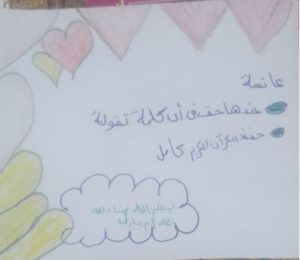
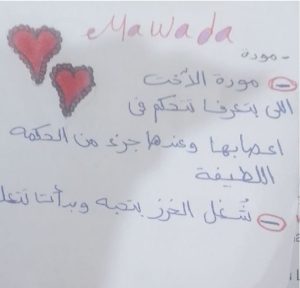
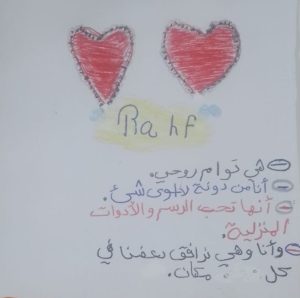
I asked each learner to write on a small piece of paper: “My classmate Farida because she is…” along with a symbol representing what her classmate likes, and then give it to her classmate as a gesture of appreciation.
For the concluding activity (ten minutes), I highlighted that “Self-confidence begins when you appreciate yourself as you are, not as others wish you to be.” I followed this with the questions: “Now, what will you start focusing on today to make you more self-confident? Who would like to share with us?”
- “I will write down all my strengths and weaknesses and analyze what I can develop and what I will try to avoid.”
- “I will start with the strengths I know about myself.”
I concluded by thanking them all and wishing each of them a happy life filled with confidence.
The learning journey was characterized by a variety of activities, with each activity smoothly leading to the next, which had a significant impact on the participants’ engagement both during the activity and throughout the entire learner eXperience. I was also mindful of time management, simplifying concepts, and using repetition in diverse ways, as well as varying the tools and methods to reinforce ideas. The range of activities, from preparatory and reflective to educational, discussion-based, motivational, supportive, and reinforcing, followed by practical application and finally a concluding activity, helped maintain the learners’ attention and engagement.
5) Transforming Learning into Performance
To implement this domain, the journey incorporated different key elements. Firstly, reflective activities were implemented, followed by the writing of a paper in which the learner expressed her feelings towards herself or others. Secondly, each synchronous applied activity was followed by an asynchronous one, encouraging the girl to experiment with what she experienced during the meeting with her school or home peers. Thirdly, the journey included practicing formative simulation activities within the group to enhance interaction and practical application. Finally, the learners were tasked with creating a research paper aimed at comparing their state before the journey began with their state afterward, thereby fostering awareness of change and growth.
The eXperience Impact
The application of FIRSTedu-ADLX Framework demonstrated a significant positive impact on me as a facilitator. I felt that the journey was enjoyable and easy, contributing to the development of my skills and methods. I reached an important insight emphasizing the necessity to spread this framework to include various community groups. Furthermore, applying the framework helped me implement my own style with conscious and well-thought-out methodology.
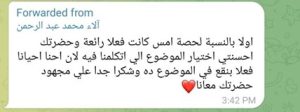
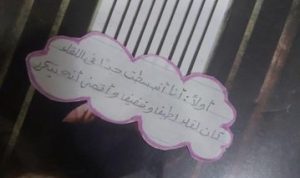
As for the learners, their reactions were overwhelmingly positive, as they expressed their wish to apply this method in studying all subjects. This indicates the satisfaction and impact achieved by the experience.
The deep effect of the experience was observed through their great enthusiasm for reading, researching, and exploring, as well as their increased engagement in discussions and the confident and clear expression of their opinions. The girls became more capable of expressing their feelings without fear or hesitation, and their relationships with each other showed remarkable improvement and greater cooperation.
On the school and community level, parents had valuable observations, especially regarding girls who were previously introverted. They noticed a positive transformation in their behavior, as they became more talkative and cheerful, and most importantly, their interaction with their mothers increased, and they showed a desire to take on some responsibilities and help their younger siblings with their studies.
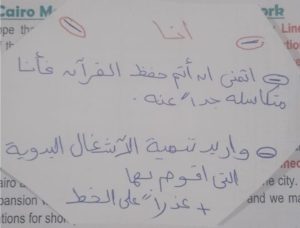
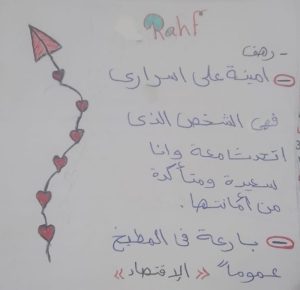
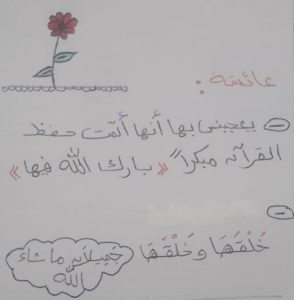
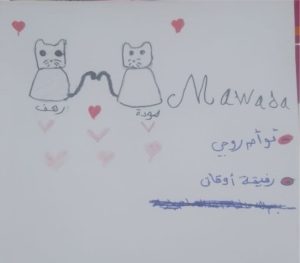
I will share with you some pictures from the journey we undertook……


Finally, I thank all those in charge of the FIRST journeys, and I especially thank the facilitator of the journey, Ms. Hanan Shaker, for her skills in facilitating learning and making its application easy for us in a smooth and engaging manner, so that the two hours spent with her in each session passed by quickly.