Abrar Abdullah Jelani
- Consultant for Establishing Voluntary Work Units According to the Saudi National Standard for Volunteering – King Fahd University of Petroleum and Minerals
- Consultant for Establishing Health Volunteering at the Health Volunteering Center
- Former Employee at Taibah University
- Al Madinah Al Monawara / Kingdom of Saudi Arabia
Participants
15 leaders and members of a student club at Taibah University, both males and females, with ages ranging from 18 to 24 participated in this learning journey.
The Impact Story of Applying FIRST-ADLX Framework
At the beginning, I would like to emphasize several points:
- One of the most notable features of FIRST-ADLX Framework is the harmony and integration among its five domains, resulting in a comprehensive reflection that truly engages the learner in an Active Deep Learner eXperience.
- This journey began with a request from a student club within Taibah University’s student organizations to organize a learner experience about “Creating Community Initiatives.”
- A previously conducted journey was selected, and significant emphasis was placed on the academic content, while also making modifications and adjustments to the activities to align them with FIRST-ADLX Framework.
- The journey’s design was carefully planned, with a focus on achieving the ASK outcomes, and taking into consideration the evolving state of the learners throughout the journey’s design and activity development. Activities were designed to accommodate both in-person and remote settings, synchronous and asynchronous interactions, and specific time allocations were set for certain activities (such as those on WhatsApp, the opener activity, and the learning activity), each lasting for 15 minutes.
- The journey started with interaction via WhatsApp, where the facilitation team introduced themselves and invited the participants to introduce themselves.
In one message, the participants were invited to share:
-their names
-their departments
– the club’s activity that excites them the most
Implementing the Domains of FIRST-ADLX Framework
Focusing on the Learner Behaviors
This domain was implemented in an asynchronous and synchronous manner. Asynchronously, through WhatsApp, I replied with an emoji to every participant once he/she introduced himself/herself. Synchronously, it was during the gathering of participants before the session, when they were asked about their specialties and were invited to mention some of the comments that were made while introducing themselves on WhatsApp.
The domain was implemented synchronously during the ice-breaking activity as well, and each participant was invited to introduce themselves (name, department, initiative they participated in, and their positive impression of themselves). Each participant wrote their name on a piece of paper and placed it in front of them so that I can easily remember their names.
Moreover, the participants were addressed by their names and encouraged to contribute, and I got closer to them during their participation, along with using body language
Opening a channel of communication with all participants and attempting to break the silence and shyness exhibited by some of them, especially those who arrived somewhat late, also helped apply this domain and helped the learners reach a good stage of integration and interaction.
Additionally, I designed a set of activities in order to focus on the Learner, the unique individual:
- Activity 1: Arranging the Initiative’s Cycle, a collaborative activity that addressed a set of questions (Where do we begin while determining the needs? What is the starting point? What is the required change to be made? fields? target participants? geographic regions?)
- Activity 2: Community Needs Identification Matrix
During the activities, I actively got engaged with the groups. I moved between them, closely monitored the learners, offered feedback, asked probing questions, assessed their progress, and demonstrated a genuine interest in their opinions and ideas.


In addition to that, I trusted the learners and provided them with diversified opportunities to share their knowledge, skills, and experiences emphasizing that we are all learners, and I learn from them more than they learn from me. I also encouraged them to share their thoughts and draw from their prior experiences by using questioning techniques (pulling techniques), allowing them to express their opinions and contribute to the learner experience effectively.
Interacting within Positive Group Dynamics
This domain was applied by designing activities with different patterns of interaction. The activities and the patterns of interaction were diversified, including individual activities like the opener (self-introduction) and the traffic signal activity, a set of group activities, and a whole-class closure. During the closure, participants were asked to stand in a circle, catch a ball thrown by others, and share their feelings. The nature of the activities varied, with some being contemplative and requiring deep thinking, others needing discussion and idea exchange, and some being physically active. Furthermore, all the activities were facilitated in a safe, friendly, and free-from-stress and anxiety environment.
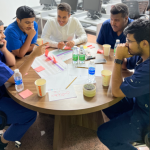

Recognizing that positivity stems from the facilitator, I ensured to maintain a friendly and welcoming character. The pre-opener activity played a crucial role in instilling a positive atmosphere among the participants, eliciting laughter, and fostering reflection on their interactions during the learning session.
At the beginning, I emphasized that in this journey, we embrace all viewpoints and opinions and accept our differences and that each of us has unique personal experiences, and we are here to learn and benefit from these experiences. I also highlighted that we need to interact and exchange viewpoints since it may lead to entirely new perspectives. Consequently, the learners’ opinions were reinforced, and they were consistently encouraged to engage in different group activities which were diversified to prevent monotony and boredom. Top of Form
Reviewing Activities within RAR
Applying this domain alone does not yield the expected results and impact without considering the other domains. Although this domain focuses on the activities and their design, I consider it the main core that leaves a practical learning impact on the participant to achieve different learning outcomes (Knowledge-Skills-Attitude). Moreover, it goes beyond that to reflect on the participant’s personal life. This way, we move towards the circle of influence in the participant’s life. This is what distinguishes the use of the RAR model and makes it the essence of the domains from my perspective. Consequently, the three stages of a RAR activity were fully respected.
Readiness Increase
- Keeping in mind that the “Readiness Increase Stage” begins with planning the journey, identifying its elements, designing the activities, considering the purpose of each activity, its tools, and its outcomes in terms of Knowledge, Skills, and Attitudes (KSA), all while prioritizing the activation of outcomes by ASK order, so I cautiously designed for all of these elements. I also developed a presentation to introduce the learner experience, sent motivational messages prior to the session, sent reminders to participants, and placed materials on each table for every group before the session began. Additionally, I prepared printed materials and tools for each activity. I even planned a detailed schedule for each activity, which included the activity’s name, format (individual, tea party, group, etc.), type (pre-opener, opener, learning activity, energizer, closure), duration, learning outcome (ASK), and energy level. Furthermore, I provided clear instructions, explained the execution method, displayed the tools used, and specified the required time.

Activity Facilitation
I monitored the participants during the activity.
Reviewing Actively
Because learning mainly occurs in the “Reviewing Actively Stage”, I selected certain activities to delve deeper into learning, as our primary focus is on applied cognitive depth and the proficiency in using crucial tools for identifying community needs, such as the Community Needs Identification Matrix. For instance, the activity depicted in the image was executed with a profound emphasis on implementing initiatives and achieving emotional depth (Attitude Learning Outcome) at a personal level
Sequencing within Session Flow
This domain significantly revolves around the learner’s state, emphasizing their high level of interaction, avoiding boredom, and their full emotional, mental, and physical presence. As a facilitator, my focus is on the learner and their learning condition, rather than concentrating solely on the activities or completing the learning material. Consequently, sequencing the activities to flow smoothly is very important starting with the very first interactions on WhatsApp. Additionally, the learner’s status during the activities (the adventure) and the learning session (the trip) was carefully considered, the energy levels and the duration of the activities were also considered which helped the participants to maintain a high level of concentration. As for the energizers, they were designed and facilitated to sustain the learner’s emotional, mental, and physical readiness.
The table below shows the sequence of some activities within the session flow:
 The learning outcomes of each activity were pulled and reviewed synchronously after each activity. Additionally, learners were encouraged to watch YouTube videos and engage in asynchronous discussions on WhatsApp to reinforce some of the concepts covered during the synchronous session. Moreover, to assist learners in summarizing what they had learned and connecting different parts, I invited the participants to collaborate in groups and create a mind map to document their learning from the beginning to the end of the journey. Subsequently, we conducted a quick revision of each group’s contribution.