Impact Story of applying the FIRST-ADLX Framework
ANBT – learning journey to cultivate values
The beginning was with an introduction between the co-founders (Nouran Elrafie & Noran Abdelaziz) in the year 2015 in a journey of Sawaed 6, which is a program of the FIRST-ADLX Framework for the community sector. After the end of the learning journey, the relationship between us deepened, especially as we shared the same goal and passion for a strong and global impact.
Then we started in the mindset, skills, and mental development by working in SeGa Group. We facilitated Sawaed and studied an Instructional Design program that contributed a lot to the design and implementation of the first steps of ANBT in May 2017.
4 Journeys of ANBT were held in 2017-2018, during these journeys many comments of the learners and facilitators were taken into consideration in order to develop the design. Starting with the fifth journey, the design reached a high stage of maturity.
One of the highlights of the FIRST-ADLX Framework is the harmony between its five domains. The activation of the five domains in the design and facilitation in a harmonious manner had the strongest impact on making the experience of the learner’s Active Deep. In this impact story, we will detail the stages that the design went through and the effect of applying the Sequencing Domain. We will focus on taking into account the state of the learner (emotional, physical, and mental) and the diversification of linking and summarizing activities.
What preoccupied us the most was the experience that the learner would live with us in the learning journey. We started describing this experience, besides it being Active Deep, we wanted it to be fun, inspiring, safe, scientific, practical, realistic, and characterized by excellence.
One of the most prominent recurrent comments after the fifth run from the learners: Are there other programs you offer? So we asked them “is there a specific topic you are looking for?” They reply: “any topic as long as it will be in the same way as ANBT Program.”
Therefore, we strived to apply the five domains of the FIRST-ADLX Framework in design and facilitation to have their harmonious and synergistic effect in creating an Active Deep Learner eXperience.
Focusing on the Learner Domain
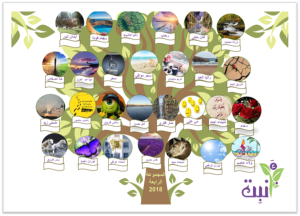
Focusing on the Learner Domain has a particularly effective impact on making every learner feel that she is the focus of the learning journey and that she is a valuable addition. A pre-opener activity was conducted at the beginning of the learning journey, in which each learner shared with us a picture she loves and how this picture related to her. We used these pictures to create a big picture of a tree with different branches. They were pleasantly surprised when they entered the training hall and found it.
Another pre-opener activity that was done online is (I need…. so, I can …..) where each learner shares what she needs in the learning environment whether from herself, the facilitators, or the rest of the learners, and how this will affect her.
The design was prepared in a way that allows opening a special channel of communication with each learner, whether by getting to know her well, answering her questions, or meeting her needs as much as possible during the learning journey. This was shown in some examples as follows:
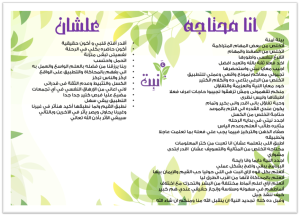
Printing the inspiring quote for each learner and hanging it on the wall.
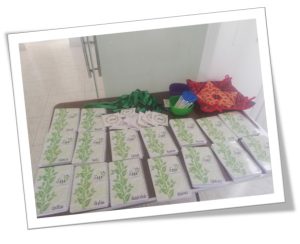
Printing each learner’s name on the nametag, notebook, and file.
Printing a tree that contains the name of each learner and the picture she shared on WhatsApp that she likes.
All the educational activities were done in a way that allows benefiting from the learners’ experiences. We listened to their comments and built on them. The artifacts that they did as missions were documented and used in the following trips. Further examples:
The learner told her story about her family’s constant travel due to her husband’s work, and this story was used to explain one of the criteria for choosing values.
One of the learners also shared the story (Tita Mofeeda) regarding leaving an impact across 4 generations and it was added to the learning materials by adding her name, trip number, and story. This encouraged other learners to document their stories to be added too.
The values booklet documents all the ideas and implementations that the learners did to cultivate values. The book contains videos, pictures, and text.
At the end of the live sessions, a customized medal is given to each learner with the ANBT logo and her name.
Interacting Within Positive Group Dynamics Domain
There was a diversification of group division ensuring that by the end of the learning journey all the learners had interacted with one another (for example pair with the person sitting to your right – pair with the person sitting to your left – JIGSAW – small groups – large groups).
After the third learning session, the learners were divided into groups according to their choice of the value that they will apply the 6 steps of cultivating values.
For increasing motivation and encouragement, the facilitators used various stickers in the learning session and customized gifs in the online interactions. We also allowed the learners to give each other stickers, for example when a colleague supports her, or she wishes to appreciate someone’s creativity.
In each learning session, there was a different shout-out. The first session was three claps and then the name. In the following sessions, the learners created their own each time.
Reviewing Actively within the RAR Model Domain-All the educational activities where designed and facilitated using the RAR Model
| Learning outcomes | The learner will appreciate the importance of values in decision making
The learner will identify some of her top values |
| Materials | A check for 100,000 L.E for each learner |
| Readiness increase | The facilitator asks the learner to close their eyes. She places a closed envelope infront of each learner. When they open their eyes, they open the envelopes. The facilitator tells them that each one has a check for one hundred thousand pounds. You are free to spend it in any way you want. Write down how you will spend it. |
| Activity facilitation | The facilitator passes around the learners, encourages them, and answers their questions, such as: Can the expenditure be on several things or one thing? How much time do I have to spend it? |
| Reviewing actively | How did you spend the money? The facilitator writes on the flipchart their answers while grouping the similar answers. After that, she begins the discussion with several questions while building on their answers. For example, what prompted you to spend this way? Was it easy for you to choose how to spend? What criteria helped you make the decision? What came to your mind when you saw other people’s answers? What have you learned about yourself? What have you learned about others? At the end of the discussion, the facilitator defines values as a set of principles, standards, and criteria that drive me to action, make decisions, and govern human life and the community members. |

Sequencing Activities within the eXperience Flow Domain
Sequencing Activities within the eXperience Flow domain had a great impact on the development, improvement, and re-design. The learning journey is based on introducing the ANBT paradigm which brings together many paradigms from Islam and various social sciences, including positive psychology. Positive psychology is the scientific study of what makes life most worth living, focusing on both individual and societal well-being. It is not only about surviving but also thriving. Considering the learner status, we had to take into account that they had different perspectives and paradigms so we emphasized that the ANBT paradigm is a proposal (not the only correct way) and she can choose from it what suits her.
In the following steps, the development of the design from one journey to another is presented:
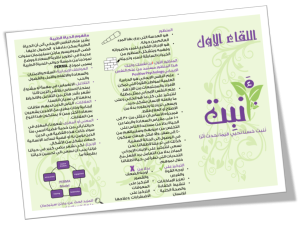
ANBT 1: The design consisted of four days written in a table format (the name of each activity and its duration). We gave out some pamphlets as summaries for the learners.
ANBT 2: The program was converted to five days based on the improvement points from the learners of ANBT 1. We added more resources to the learner’s pamphlets. We created summary cards for the facilitator for each day.
ANBT 3 and 4: A facilitator’s guide has been written for the main learning activities of the program.
ANBT 5: The facilitator’s guide has been redesigned and written in detail for all the main learning activities and experience activities (opener, energizer, etc.). Enrichment videos were also made.
Taking into account the learner’s status to maintain the flow during the Learner eXperience (LX).
Previously, we used to present ANBT in one learning session. After observing and taking notes of the learners’ comments, we found that it does not consider the learners’ physical status (lots of physical activity while it is the first day and they are not ready for this type of activity). It also does not take into account the cognitive and mental status (a lot of scientific and educational terms).
With regard to taking into account the learner’s physical status:
The learners were given appropriate readiness before the learning session by explaining that the session will have some activities that require movement. This had a good effect, as the learners were prepared that they would not sit for five hours, which prompted some of them to wear comfortable clothes and sports shoes.
Also, the activities have been varied so that many of them do not require much movement.
As for taking into account the learner’s cognitive and mental status:
The ANBT paradigm was divided into two days, and asynchronous learning was used (between learning sessions) to deepen the learning with videos and articles, instead of compressing them all in the live learning sessions.
In addition, summaries of the most important information were distributed, and the names of the sources were written for those who would like to know more. I do not forget that we mentioned the name of a book in the sources (The Impact of Man in His World by Muhammad Musa Al-Sharif). I was surprised that by the next session some learners read it within two days and summarized the most important points mentioned in it after they were very affected by what they experienced in the learning session.
To ensure sequencing within the session flow during the learner experience, the linking and summarizing activities used were varied, for example:
- Write a slogan for the ANBT paradigm.
- Writing the keywords discussed in the session on each other’s back using her fingers and the other participant will guess what is the word.
- Use hand gestures to express each component of the ANBT paradigm.
- Create a 3D model of the ANBT paradigm.
- Each letter in the word ANBT in Arabic is an acronym of a component of the paradigm.
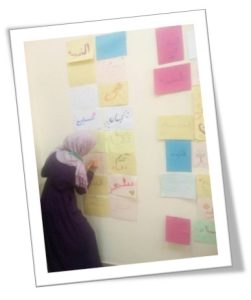
- Heart – Mind – Hands: Using small sticky notes: write an idea or information you have learned and stick it on your head – write your feelings on a sticky note and stick it on your heart – write an action or step that you will take on a sticky note and stick it on your hands.
- Mind map activity: The learners created a mind map for all the learning sessions.
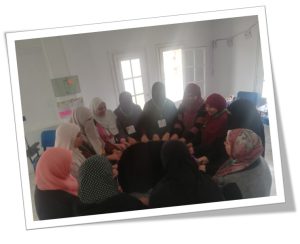
- Circle activity: everyone stands holding a rope with a knot, the facilitator closes his eyes and makes any sound, and the learners move the rope, when the facilitator stops, the person at whom the knot stood says any keyword or an important phrase said during the session.
Transforming Learning into Performance Domain
To ensure the implementation and impact of the Active Deep Learner eXperience (ADLX), several steps were taken, including:
- Interactive activities on the WhatsApp group with fixed dates, in which all learners participate
- Follow groups while reviewing actively and evaluate their discussions and interactions
- Open discussions and listen to their comments.
- After completing each step in the cultivating values model, the learners applied the step with a value of their choice.
- During the learning journey, they experienced the cultivation of the value of optimism.
- Different groups of values were followed up in the live sessions and also in the WhatsApp groups.
- A questionnaire is made for the learners to choose the next value.
- We gave them attractive visual prints that help them review and apply the information.
- After the learning journey ends, the learners join the following groups
ANBT WhatsApp group for socializing: for social communication between all the learners from the different rounds.
ANBT WhatsApp group for values: The ANBT model for cultivating values is implemented by activating a value every 3 months.
Facebook Group: All the content is placed in the form of learning units