- Introduction
Khaled Elkilany is an Egyptian educator whose journey in education has taken him across continents, countries, cultures, and classrooms. He holds three bachelor’s degrees: one in English Language and Literature, another in Arabic Language and Humanities from Dar Al-Uloom University, and a third in Islamic Studies from Mishkah University. His studies demonstrate a profound interest in language, faith, and human experience. Later, he received a scholarship to complete a Master’s in Fiqh and Usul at Mishkah University, and he’s currently pursuing his Master’s research in Educational Leadership and Management at the University of Derby in the UK. He also holds a minor in Social Sciences from Nama’a Research Centre in Morocco — all of which shape his well-rounded view of learning and leadership.
Mr. Khaled began teaching English at an international school in Egypt, where his passion and commitment quickly led to leadership roles as Head of Department and later as Academic Supervisor. He then moved to Turkey to become the principal of an international American school, working with a diverse team from across the Middle East and Asia. Currently, he leads Fukuoka Islamic International School (FIIS) in Japan, where he balances international standards, Japanese culture, and Islamic values to foster a meaningful and inclusive learning environment. His experience working with people from different cultures and backgrounds has shaped his leadership style — one that values diversity, respect, and shared purpose.
Mr. Khaled learned about FIRST-ADLX Framework in Turkey during a quiet conversation with, Mr. Bahgat. At first, it seemed like just another educational model. He read the book, but it didn’t quite resonate. The ideas felt somewhat distant and challenging to put into practice. However, years later, while teaching Learning Theories as part of his Master’s programme and running a small Islamic school in Japan, everything became clear. The challenges he faced as a leader and the questions he asked as a learner brought the framework to life. He began to see how FIRST-ADLX— with its five domains of Focusing on the Learner Behaviors, Interacting within Positive Group Dynamics, Reviewing Activities within RAR Model, Sequencing Activities within the Session Flow, and Transforming Learning into Performance — wasn’t just a theory. It was a practical, meaningful guide that connected deeply with his academic understanding and personal values. Mr. Khaled realised that FIRST wasn’t just about teaching methods and creating genuine, lasting learning experiences. It provided him with a clear path to help students develop in knowledge, character, and purpose. Today, this framework influences how he leads, teaches, and supports his school community, always aiming to nurture capable, ethical, and well-prepared learners to impact the world positively.
At Fukuoka Islamic International School in Japan, Mr. Khaled faced challenges common to many young schools, but with layers of complexity shaped by its unique context. Despite having a highly qualified team — including several PhD holders — the school lacked unified teaching practices. Classrooms operated in silos, learner engagement was inconsistent, and the school’s seven core goals remained more aspirational than embedded. With 18 teachers and 55 students from KG1 to Grade 6, the school was intimate and full of promise, yet its systems were still forming, and its resources were quite limited.
One of the most pressing challenges came not from a lack of expertise, but from deeply ingrained mindsets. Many teachers, shaped by years of traditional academic training, held firm to a teacher-centered paradigm. Knowledge was seen as something to be delivered, and authority rested heavily in the teacher’s hands. This was further reinforced by the broader cultural context of Japan, where teachers are deeply respected and often viewed as unquestioned figures of knowledge. The very culture that honored educators also made it more difficult to shift toward a learner-centered approach.
FIRST-ADLX Framework, with its focus on Focused, Individualized, Reflective, Sequenced, and Transformational learning, introduced a different philosophy — one where learning is a journey, not a delivery; where the student is an active participant, not a passive receiver; and where the teacher is a guide, not just a source. Mr. Khaled saw in FIRST a powerful answer to the pedagogical inconsistencies and the absence of a shared educational language. But introducing it meant gently confronting not only institutional habits, but cultural traditions as well.
Change didn’t come easily. Some teachers resisted — not because they lacked passion, but because they had spent decades being shaped by systems where the teacher’s authority was central and unquestionable. Many were older and more experienced, which made Mr. Khaled’s task even more delicate. He also wrestled personally with how to deliver this transformation: Should I act as a principal with authority, or as a facilitator with influence?
Mr. Khaled chose the latter. Instead of issuing directives, he modelled the framework through daily practice, collaborative planning, and quiet leadership. He wove FIRST into coaching conversations, teacher training, and school-wide reflections. Recognising the need for coherence, he expanded the school’s six original goals to seven, aligning them closely with learner outcomes inspired by the FIRST-ADLX principles. Then, he took a bold step— he ensured that every single lesson plan, across all departments and subjects, was structured around three clear categories of learning outcomes: main, parallel, and performance. Each outcome was explicitly linked to one or more of the seven school goals, ensuring no lesson was disconnected from the broader educational vision.
But the integration didn’t stop in the classroom. Mr. Khaled also restructured the school’s co-curricular and extracurricular programs — from quarterly projects and clubs to school-wide events — so that each activity served the same set of goals and was driven by the same outcome-based thinking. Whether students debated, experimented in science fairs, or participated in cultural days, the learning was intentional, measured, and aligned with the Focused, Individualized, Reflective, Sequenced, and Transformational pillars of the FIRST framework.
Through this unified approach, the framework became more than just a leadership tool — it became the school’s DNA. It tied together academic learning, life skills, Islamic values, and personal development under one learner-centered vision, creating a school culture where everyone — teachers, students, and leaders — spoke the same educational language and moved toward the same transformative goals.
- Learning Design Overview
The decision to adopt FIRST-ADLX framework at Fukouka School was motivated by its comprehensive and scientifically based approach to learner experience. This aligned perfectly with the school’s mission to provide both academic excellence and Islamic character education. Unlike fragmented approaches that often separate teaching from values or isolate planning from impact, FIRST offered a coherent model that integrated classroom practice, leadership development, coaching culture, and institutional vision.
What made FIRST particularly suitable was its focus on transformation—not only in learners but also in facilitators, teams, and school systems. Mr. Khaled recognized it as a structured method to unify the entire school around a common language, turning lesson planning from a checklist exercise into a meaningful process centered on Attitude, Skills, and Knowledge outcomes.
Learning Outcomes
- Attitude: Appreciate adopting FIRST Framework as a whole-school philosophy and mindset.
- Skills: Apply FIRST Framework across teaching, planning, and leadership levels.
- Knowledge: Understand the principles and domains of FIRST and how they inform daily school decisions.
The journey began with Mr. Khaled spreading awareness of the framework informally, embedding it into conversations and seeding curiosity among staff. This led to Wave One, the online Entry Journey, where the initial signs of a paradigm shift began to surface as private discussions sparked mindset change.
Wave Two, the Introductory Journey, marked the point where teachers started to see the practical value of FIRST. They began using its terminology in daily interactions and recognized its relevance to their actual school context.
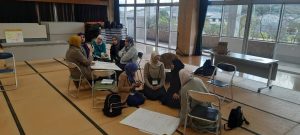
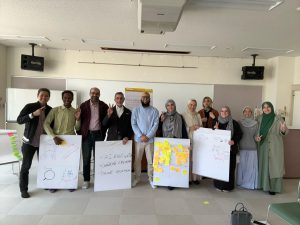
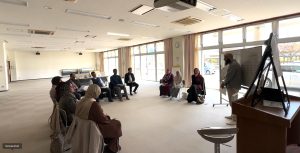
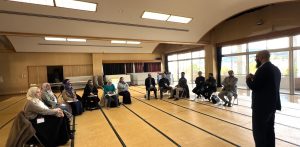
Wave Three was the true foundational stage—spanning three months and consisting of synchronous in-person learning trips, collaborative planning sessions, and group or private pair reflections. As the journey evolved, teacher ownership increased progressively as their confidence grew, and what began as exploration soon turned into co-design and co-facilitation in some cases, starting to form a professional learning culture grounded in the principles of FIRST.
III. Journey Implementation Process
The implementation of the FIRST-ADLX framework at Fukouka School unfolded as a school-wide learning journey guided by three progressive waves. Each wave reflected an evolving level of understanding, confidence, and application among the teaching staff.
In Wave One, the Entry Journey served as a light-touch introduction aimed at raising curiosity and starting private and group conversations about FIRST. Teachers were not yet expected to implement, but rather to observe and reflect. This stage planted the seeds of a paradigm shift and opened a reflective dialogue within the school culture.
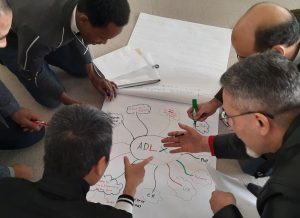
In Wave Two, known as the Introductory Journey, teachers began to explore the deeper philosophy of the framework and experiencing its five domains. They engaged with the core concept of “Active Deep Learner eXperience,” breaking down what it means for learning to be active, deep, and rooted in the Learner eXperience. This wave also elaborated on the Holistic Map (previously introduced in the Entry Journey), which helped visualize how various elements of the school ecosystem connect through FIRST. Teachers began to appreciate the possibility of real integration and started using FIRST terminology in their daily interactions.
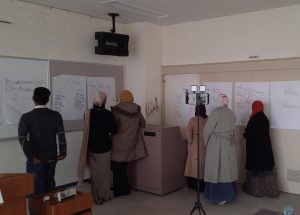
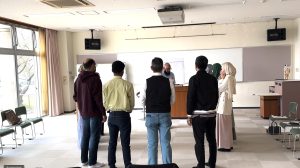
In Wave Three, the foundational phase, the focus shifted to practical implementation. Dr. Khaled led onsite learning sessions that centered around the 1st three domains of FIRST: Focusing, Interacting, and Reviewing. Teachers were supported in translating these domains into their lesson planning and facilitation. As confidence grew, so did ownership, and the school witnessed a noticeable shift in how teachers thought about their roles, their learners, and the purpose of their instruction. The process emphasized trust, consistency, and the development of a professional culture grounded in shared values and continuous improvement.
- FIRST Domains in Action
While not all domains have been fully implemented across all classrooms, and some domains have seen application in certain areas more than others, the school is clearly on the right track. The foundation laid out so far offers strong evidence of commitment and growing alignment, and the direction is promising. It is important to note that no clear criteria have yet been established to formally evaluate the level of implementation. The reflections shared below are based primarily on observable shifts and anecdotal stories shared by teachers and staff.
F – Focusing The principle of Focusing was activated through individualized coaching conversations and structured reflection sessions. Teachers were encouraged to personalize their approaches and recognize the unique strengths and growth areas of their students. Trust in the learner was emphasised by shifting from rigid instructional models to flexible facilitation that allowed learners to lead discussions or offer input in shaping lesson flow. These practices began cultivating a sense of ownership in both teachers and students.
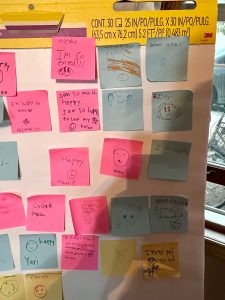
I – Interacting Creating a warm and cohesive learning environment was central to Interacting. In workshops and follow-up sessions, Dr. Khaled fostered a spirit of collaboration and psychological safety by modelling vulnerability, humor, and kindness. Teachers were paired for shared lesson planning and encouraged to observe and support one another, which deepened collegial bonds. Energizers and collaborative tools were introduced not just for student use, but as a way to renew staff morale and group cohesion.
R – Reviewing Reflection was intentionally built into every phase of the implementation process. Teachers were invited to revisit their lesson goals and facilitation choices after each wave. Reviewing practices ranged from informal hallway conversations to structured feedback forms and discussion circles. These reviews often prompted changes in future planning and highlighted moments of learner impact, reinforcing the purpose behind the framework.
The domains of Sequencing and Transformation were not yet facilitated in the school’s training sessions, so their implementation has not been observed or evaluated at this stage.
- Challenges
Implementing the FIRST-ADLX framework in a school environment with diverse educational backgrounds came with multiple challenges. Some educators, particularly those with formal training in educational sciences, initially questioned the added value of the framework, believing it offered nothing fundamentally new. Building buy-in required patience, credibility, and persistence. There was also uncertainty about how to proceed after each journey—what steps to take, how to maintain momentum, and how to ensure continuity. Additionally, the lack of a clear, shared set of evaluation criteria made it difficult to track progress in a structured way.
Resistance to lesson planning and a tendency to rely on AI tools rather than deep design thinking added another layer of complexity. While mindset shifts began to occur, sustaining motivation and encouraging consistent application across staff remained an ongoing effort.
- Recommendations and Suggestions
For schools beginning their FIRST journey, it is essential to align leadership vision with the framework’s philosophy from the outset. Building trust and modelling vulnerability as a leader can help ease skepticism and open the door to honest dialogue. Introduce the framework gradually through waves of experience, and embed real-world applications early to show their practical value. Facilitate follow-up and classroom observation, not for supervision, but as part of a shared learning process. Establish clear, context-sensitive criteria to evaluate implementation and create spaces for peer support and collaborative lesson planning. Above all, invest in cultivating a professional culture rooted in safety, reflection, and purpose. When teachers feel seen, heard, and trusted, real change becomes possible.
VII. Conclusion and Reflection
The introduction of the FIRST-ADLX framework at Fukouka School has brought about a shift not only in language and tools but also in mindset and culture. Teachers now speak a shared professional language rooted in learner-centered design, and the atmosphere has grown more collaborative, reflective, and emotionally safe.
The impact on participants has been evident in informal feedback and classroom behavior. Teachers have expressed newfound clarity, enthusiasm, and a sense of professional pride. Several shared how their facilitation practices began to feel more purposeful and how they were rethinking their role in the learning process. Some even described how the positivity they experienced at school extended to their personal lives and relationships. While systematic evidence is still being developed, these narratives reflect authentic change.
For Mr. Khaled as a facilitator and school leader, the framework has become a unifying lens through which planning, communication, and leadership decisions are made. His role shifted from instructional authority to learning coach, modelling the same trust and learner-centred mindset he hopes to see in others. He now sees the school not just as an institution delivering content, but as a living journey that supports transformation.
Looking ahead, the vision is to fully integrate the framework across all domains and ensure every educator becomes not just an implementer, but a facilitator capable of transferring the philosophy to others. The ultimate goal is for FIRST to become embedded in every aspect of school life—curriculum design, staff development, family partnerships, and learner journeys—enabling a sustainable and spiritually grounded culture of learning and impact.