Mr. Mahmoud Abdelkader Ramadan – Al-Isra’ and Al-Mi‘raj

Introduction

About the Facilitator and the Learners

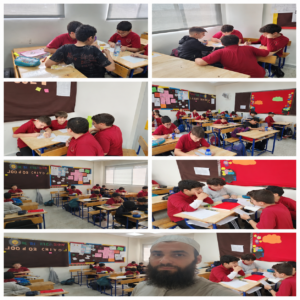
Mr. Mahmoud Abdelkader Ramadan is a facilitator of Islamic Education and the Holy Quran from the Lebanese Republic, and he works in the city of Beirut. He facilitates learning for school students at the basic education stage and is keen to employ the FIRSTis-ADLX Framework in designing and facilitating learning journeys that contribute to building an Active Deep Learner eXperience. A group of male learners participated in this eXperience, with an average age of (12) years, totaling (16) learners within a school classroom environment in Beirut, Lebanon.

Topic of the Learning Session

The session focused on extracting the lessons learned from the event of Isra and Mi’raj, while ensuring that knowledge was transformed into practical attitudes and applicable behaviors in the learners’ lives, so that learning would not be limited to knowing the events of the story, but would extend to bringing its values and impact into reality.

eXperience Design Overview

Why the FIRSTis-ADLX Framework?

The FIRSTis-ADLX Framework was selected because it provides a methodology that helps build a genuine eXperience for learners and reorganize the outcomes of the session in alignment with the domains of the framework, while ensuring that all steps are implemented smoothly and that the basic outcomes and parallel outcomes are achieved during the learning session.

Learning Outcomes

Attitude Outcomes

  • To love the Prophet, peace and blessings be upon him.

  • To honor the event of Isra and Mi’raj.

  • To have certainty in the words of the Messenger of Allah, peace and blessings be upon him.

  • To realize that after every hardship there is a gift from Allah Almighty.

Skills Outcomes

  • To be patient in the field of calling to Allah Almighty.

  • To give precedence to the words of the Messenger of Allah, peace and blessings be upon him, over what the eyes see and the ears hear.

  • To comply with the commands of Allah, Glorified and Exalted, and refrain from what He has prohibited.

Knowledge Outcomes

  • To be familiar with the event of Isra and Mi’raj and the stage before and after it.

  • To speak about the value of Al-Aqsa Mosque.

  • To recall some of the miracles with which Allah, Glorified and Exalted, supported His messengers.

Performance Outcomes

  • To prioritize  the words of the Messenger of Allah, peace and blessings be upon him, over personal opinions and ideas.
Summary of the Learning Session

The session began with an opening activity to get to know the learners and identify the interests of each one of them. They were then divided into cooperative groups that would continue throughout the eXperience. After that, the outcomes of the session were clarified so that each learner could follow the extent to which they were being achieved during learning. The learning material was divided into four parts, and each group was assigned a part of the story of Isra and Mi’raj to present in the way it considered appropriate, while the remaining groups were responsible for providing feedback on their peers’ presentations.

Before beginning the main activity, a short video appropriate for the learners’ ages about the event of Isra and Mi’raj was shown, and each group was invited to write down the lessons and insights derived from it. The opportunity was then opened for everyone to participate for the purpose of probing and assessing before moving on to the learning material. After that, an energizer activity was implemented with the aim of boosting energy before beginning the main cooperative activity, in which the roles of the groups were integrated through presenting the parts of the story according to clear roles and specified times. At the end of the session, each learner individually wrote down the lessons he had extracted and then expressed how he would transform them into practical application in his daily life.

A Learning Activity Using the RAR Model

Readiness Increase
The facilitator shared the instructions, divided the learners into groups, and showed a short video that introduced the topic of Isra and Mi’raj. The learning material was also distributed, its relationship to the video was clarified, the time and roles for each group were specified, and the clarity of the implementation method was ensured before beginning the activity.

Activity Facilitation
Each group worked on discussing the part of the story of Isra and Mi’raj assigned to it in the way it had chosen, while the facilitator was keen to follow the progress of the work, guide the discussions, maintain the learners’ interaction, and draw their attention to the importance of participating in the discussion, while reminding them of the time and the importance of being ready to share what they had discussed after the discussion stage ended.

Reviewing Actively
After the presentations ended, the learners reflected on what they had learned from the learning material and the discussion around it, then discussed the importance of those lessons in their reality, before each learner individually wrote down the most important lessons he had gained and practically identified how he would translate them into attitudes and behaviors in his daily life, making the learning extend beyond the end of the session.

Applying the Domains of FIRSTis- ADLX Framework

Focusing on the Learner Domain

The facilitator implemented this domain by conducting an opening activity that allowed him to get to know all the learners by their names and hobbies, which helped build positive communication with them from the beginning of the learning session and created an appropriate space for considering the individual differences among them throughout the activities.

 Interacting within Positive Group Dynamics Domain

This domain was achieved by dividing the learners into cooperative groups, dividing the learning material into four parts, and involving all learners in the discussions and evaluation of the presentations, while emphasizing integration among the groups through exchanging the lessons learned and information, which helped build a shared understanding of the event.

Reviewing Activities within RAR Domain

This domain was applied by preparing the learners before the activity, then distributing the learning material and tools, explaining their connection to what had preceded them, specifying the time and roles, and ensuring that the implementation method was clear. During the activity, the learners were guided, their attention was maintained, and they were encouraged to participate. The opportunity was then opened for everyone to provide feedback and reflect on the learning outcomes.

Sequencing within Learner eXperience Domain

The activities were arranged progressively, beginning with identifying the outcomes of the session, then getting to know the learners, followed by the opening activity, the video presentation, dividing the groups, distributing the learning material, presenting the groups’ work, group and individual feedback, extracting the lessons learned, and finally translating them into practical applications in the learners’ lives, which maintained the smooth flow of the session and the interconnectedness of its stages.

Transforming Learning into Performance Domain

Throughout the eXperience, the facilitator was keen to repeatedly draw out the objective of studying the biography of the Prophet, peace and blessings be upon him, and emphasize that it is not limited to knowing events, but rather involves reinforcing values, feelings, and morals and translating them into practical practices in life. At the end of the session, each learner individually wrote down the practical aspects he would commit to applying and identified the areas in which he would apply them. Copies of these commitments were then collected for follow-up during the remainder of the academic year.

Conclusion and Impact of the eXperience

Impact of Applying FIRSTis-ADLX Framework on the Facilitator

The facilitator says: “I became more engaged with the learning material I present, and I noticed a clear increase in the learners’ interaction, which raised my level of motivation and contributed to reducing boredom among the learners. I also realized that traditional learning methods no longer achieve the desired impact and that developing the facilitator’s practices has become a necessity, especially in light of the tools provided by the FIRSTis-ADLX Framework that help achieve learning outcomes more effectively. The shift from the direct presentation method to balancing between pulling and pushing was a reason for making the learning process more enjoyable and more effective in achieving the learning outcomes.”

Impact of Applying FIRSTis-ADLX Framework on the Learners

The learners enjoyed this session, and the learning time passed without a feeling of boredom. Everyone’s motivation to participate increased, which contributed to building a positive learning environment. The learning outcomes were also achieved more easily, and the feedback showed a noticeable improvement in the level of understanding among some learners with limited abilities, which reflected the impact of focusing on the learner within FIRSTis-ADLX Framework. The impact of the framework’s domains was also clearly evident through the level of participation, performance, and the general feeling of enthusiasm throughout the duration of the session.

Impact of the Application on the School or Community

The facilitator was keen to share this eXperience with a number of colleagues. He also invited some close acquaintances to explore the learners’ opinions about the class and the extent to which they benefited from it. The feedback was positive and contributed to strengthening his conviction regarding the usefulness of this framework. A number of colleagues expressed interest in experiencing FIRSTis-ADLX Framework, while others who were already familiar with it expressed their surprise at the amount of enjoyment and creativity that its application brought into the classroom environment.

The facilitator concluded by saying: “Among the well-known sayings is: ‘If your hand falls short of giving a reward, let your tongue extend in thanks and supplication.’ Rewarding the one who does good is an innate character that arises from loyalty, for hearts are naturally inclined to love those who are good to them, and a believer cannot be grateful to Allah Almighty until he acknowledges the merit of those who deserve recognition. The Messenger of Allah, peace and blessings be upon him, said: ‘Whoever does not thank people does not thank Allah,’ and he also said, as narrated by Usama ibn Zayd, may Allah be pleased with him: ‘Whoever has a good deed done for him and says to the one who did it: May Allah reward you with goodness, has expressed the fullest praise.’

We share with you some pictures from the session

Write a comment