About the Facilitator
Mr. Ibrahim Mohamed Ibrahim Al-Farmawy is a facilitator from Egypt. He is 30 years old and holds a Higher Certificate in Qur’anic Recitations from Khatam Al-Mursaleen Institute in Al-Omraniyah, as well as a qualification in Computer Science from IJI Institute. He has experience in teaching Qur’an, Tajweed, Qur’anic interpretation (Tafsir), and Islamic sciences, and currently serves as an Imam of a mosque.
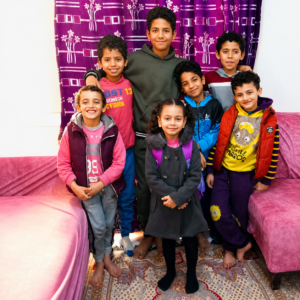
This learning journey focused on facilitating the memorization and interpretation of Surah Al-Bayyinah to a group of children in Hadayek October, Giza, Egypt. The participants were seven boys and girls between the ages of 7 and 12. They had already memorized a number of short “Surahs” of the Qur’an and were “recognized as intelligent, active, and eager to learn.
Introduction to the Implementation Story
This learning journey focused on the memorization and interpretation of Surah Al-Bayyinah, including its reasons for revelation and helping learners understand how the meanings of the Surah could influence their daily lives and worship.
Learning Outcomes
By the end of this learning journey, learners were able to achieve the following:
Attitude Learning Outcomes
- Appreciate the blessing of Islam bestowed upon them by Allah.
- Appreciate the virtue and status of the Prophet Muhammad (peace and blessings be upon him).
Skills Learning Outcomes
- Recite Surah Al-Bayyinah correctly while applying the rules of Tajweed.
Knowledge Learning Outcomes
- Explain the meanings of the vocabulary of Surah Al-Bayyinah.
- Identify the reasons for its revelation.
- Define the concept of sincerity (Ikhlas).
Parallel Learning Outcomes
Attitude
- Develop the spiritual atmosphere experienced throughout the learning journey.
- Strengthen the values of cooperation, participation, and teamwork.
Skills
- Learn how to upload a document through WhatsApp.
- Practice recitation using the Kurd Maqam.
Knowledge
- Learn strategies for distinguishing between similar Qur’anic verses.
Performance Outcomes
Attitude
- Strive to practice sincerity for one week as a means of self-development.
- Continue communicating with one another through a WhatsApp group.
Skills
- Manange time and agree on a specific time to gather, with one learner leading the prayer using Surah Al-Bayyinah while reciting it using one of the Maqamat studied during the learning journey.
Knowledge
- Introduce younger relatives to teh lessons learnt from Surah Al-Bayyinah.
Description of the Implementation Story
At the end of one of my Qur’an memorization circles, before experiencing FIRSTis-ADLX Framework, I asked the learners to answer several motivating questions that I had written in their notebooks about Surah Al-Bayyinah.
During the following session, I began with an Opener in which the learners discussed and corrected their answers to those questions.
Afterward, I facilitated a cooperative research learning activity by dividing the learners into two teams. Each team searched for brief explanations of the meanings of Surah Al-Bayyinah within a specified time. They then presented their findings, and I corrected any misunderstandings.This was followed by an auditory learning activity where learners listened to a recording of Surah Al-Bayyinah by Sheikh Muhammad Siddiq Al-Minshawi and repeated after him for ten minutes. A linking and summarizing activity was then conducted using a true-or-false exercise.
The session concluded with a closure activity in which learners described the meeting in a single sentence and pledged to practice what they learned, recite Surah Al-Bayyinah in their daily prayers for a week, and teach what they learned to their friends.
The journey extended beyond the session by transforming learning into tangible, real-world application. The design of the journey took into account the variety between learning activities and experiential activities, logical progression, and learners’ energy levels, in alignment with the domains of FIRSTis-ADLX Framework.
Using RAR Model
Readiness Increase: Participants were invited to prepare for the activity by viewing a bottle of drinkable water and four small containers of soil, each labeled with a disease of the heart: showing off (Riyaa’), seeking fame (Sum’ah), self-admiration (‘Ujb), and superiority over others. The facilitator also prepared them by activating their prior knowledge regarding the concept of sincerity (Ikhlas), eliciting their thoughts, and checking and refining certain concepts before starting the activity facilitation phase.
During the Activity Facilitation phase, two learners volunteered to participate hands-on. One of them drank from the water to demonstrate that it was suitable for drinking, then a small amount of soil from one of the containers was added, changing the water and making it unfit for consumption. This process was repeated with the remaining containers while the rest of the learners observed, reflected, and actively engaged, all within the designated time frame.
After the facilitation phase concluded, Reviewing Actively started. Participants were invited to reflect on what they had observed by answering key questions: What? What did you observe during the activity? So What? What is the significance of this? What does the spoilage of the water symbolize, and how does it relate to sincerity and diseases of the heart? Now What? What actions will you take to maintain sincerity in your lives? They then extracted the key lessons learned and the practical steps they would commit to implementing after the session.
Applying the Domains of FIRSTis-ADLX Framework
F – Focusing on Learner Behaviors
I never forced any learner to participate in the activities. Instead, I encouraged voluntary participation and addressed every learner using the name they preferred, helping create a welcoming and respectful learning environment.
I – Interacting within Positive Group Dynamics
The learners were divided into two groups and actively carried out the activities themselves, allowing them to collaborate and participate directly throughout the learning journey.
R – Reviewing Activities within RAR Model
The RAR model was clearly applied in the activities, as illustrated in the example in the previous section:
- Increasing Readiness (R): Began by preparing the materials, sharing instructions, and motivating learners to engage.
- Activity Facilitation (A): Followed through active participation and interaction among learners during the activity.
- Active Review (R): Concluded when the facilitator invited learners to reflect on their experience, draw key lessons, and identify future actions based on what they learned.
S – Sequencing within the Learner eXperience
The session followed a progressive sequence, starting with a pre-opener, followed by a cooperative learning activity, another learning activity, an auditory learning activity, a linking and summarizing activity, and finally, the closure. This structure provided a logical transition between activities while ensuring variety and alignment with the learners’ level.
T – Transforming Learning into Performance
The learners were invited to recite Surah Al-Bayyinah during their prayers for one week so that they could master it and allow its meanings to have a greater impact on their hearts.
They were also asked to share with their friends the lessons learnt from the Surah.
Impact of Applying FIRSTis-ADLX Framework
Impact on the Facilitator
Applying FIRSTis-ADLX Framework changed my perception of learners. I realized that they are not passive recipients of knowledge but individuals with feelings, challenges, and unique characteristics.
The framework also helped me transform learning into real-life performance and made the learning sessions enjoyable rather than routine or boring.
Impact on the Learners
One learner commented,
“Is this how you see learning, Sheikh? It is so enjoyable!”
Another learner said,
“You are the first teacher who gives us feedback.”
All the learners, without exception, became active participants and leaders in the learning circle, whereas previously only one or two learners usually participated.
The learner-centered approach had a clear positive influence on their engagement.
Impact on the School or Community
After creating a WhatsApp group that included both parents and learners and sharing parts of our learning journey, parents regularly expressed their appreciation for the work being done and shared how they had noticed significant positive changes in their children.
Conclusion
Finally, I would like to express my sincere gratitude to everyone who contributed to this unique educational initiative: Eng. Mohamed Bahgat, Dr. Yasser El-Fiqi, Eng. Mohamed Fayyad, and all those involved.
May Allah forgive us all and reward everyone with goodness.