About the Author
Ms. Hiba Alaa Al-Din Khartabil is a Palestinian educator residing in Lebanon. She holds a Bachelor’s degree in Biotechnology and a Master’s degree in Diagnostic Molecular Biology and Human Genetics. Her professional journey spans roles as a neurogenetics researcher, science teacher, project coordinator and program implementation lead at Helping Hand USA, program manager at the Skills Development Institute, case manager at NISCVT, and child protection officer at Terre des Hommes Italy (Lebanon). Additionally, she serves as a student affairs officer in a vocational training scholarship program and an extracurricular programs officer at a center for training and development. She is also a youth mentor, life skills designer and trainer, instructor for Islamic youth courses, and student of Islamic sciences.
Learning Outcomes
After experiencing the FIRSTorg-ADLX learning journeys, I felt deeply enthusiastic about applying the domains, principles, techniques, and modern tools I had learned. Striving to make a sustainable impact on our rising generations, I aimed to integrate these elements into the learning journeys I design and facilitate.
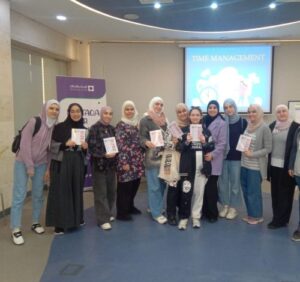
To put this into practice, I designed and facilitated a Time Management learning journey for a group of female learners at a center in Lebanon, marking the one-year anniversary of their first meeting in an Islamic education session titled “So Remind.”
I built the journey on the FIRSTorg-ADLX Framework to achieve an Active Deep Learner eXperience (ADLX), with the following learning outcomes:
Attitude Learning Outcomes
- To appreciate the importance of time.
Skills Learning Outcomes
- To determine the time required for activities and projects.
- To arrange priorities correctly.
Knowledge Learning Outcomes
- To define the Wheel of Balanced Life.
- To identify the importance of maintaining balance within it.
Performance Outcome
- To manage time wisely and appropriately.
The Sequence of Activities and the Implementation of the Five Domains
Inspired by what I learned in the FIRST journeys, I designed a set of eXperience Activities and Learning Activities while considering the five domains of the framework in all activities. The activities varied and were sequenced as follows:
1 – Opener Activity for Icebreaking
I prepared a collection of positive qualities and invited the learners to choose one quality for themselves. The activity enhanced positive interaction and created a safe environment for interaction and learning. Using a unique quality for each learner also helped achieve the principle of Individualization under the Focusing on Learner Behaviors Domain.
In this activity, I was keen on increasing the learners’ readiness by providing instructions, guiding them to the cards, and encouraging them to begin the activity. During the Activity Facilitation stage, I encouraged, motivated, congratulated, praised, and thanked everyone for their participation. I also ensured everyone interacted and that each learner received a distinctive quality that reflected her uniqueness.
At the end of the activity, what caught my attention was the learners’ unanimous agreement that they felt they belonged to one group for the first time, despite having known each other for a whole year.
2 – First Learning Activity – How Much Time Is One Minute Worth?
During this activity, I invited the learners to sit quietly, close their eyes, and remain still for one minute. The activity aimed to help them feel the importance and value of one minute and connect this concept to their daily experiences. It fulfills the principle of Reflection on Reality under the Transforming Learning into Performance Domain.
I respected the RAR Model and applied the third domain (Reviewing Activities within RAR Domain) with its three principles: Readiness Increase, to Activity Facilitation, and Reviewing Actively.
During the Readiness Increase stage, I prepared the learners psychologically, mentally, and physically for the activity, provided them with instructions, and asked them to repeat them.
During the Activity Facilitation stage, I accompanied, participated, followed up, and ensured everyone’s participation.
During the Reviewing Actively stage, I elicited thoughts and feelings and facilitated learners’ connection between the importance of time and their reality and daily lives. During this stage, the attitude learning outcome of the session was elicited, and it also helped learners determine the time needed for each activity or project they undertake.
3 – Second Learning Activity – The Wheel of Balanced Life
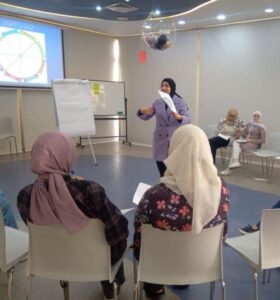
I ensured the learners’ readiness, explained the instructions clearly, and distributed a Wheel of Balanced Life template to each learner. I also elicited the importance of this wheel and the necessity of maintaining balance among its various elements.
During the Activity Facilitation stage, I gave each learner the time and freedom to use the wheel to discover her own way of life.
The Reviewing Actively stage was dedicated to reflecting on reality and linking learning to real performance. The learners reflected on their lifestyles and identified their goals and future tasks, in addition to clearly defining future steps for managing their time wisely and achieving balance among all life domains represented in the wheel. Some learners shared their plans with the group, and positive constructive feedback was exchanged.
4 – Third Learning Activity
After each learner had identified her goals and tasks in the learning journey, we moved to an activity that helped identify unproductive periods of time and activate them by using them to achieve goals so that these hours would become valuable opportunities for accomplishment.
I divided the learners into three groups and provided each group with a template that included all routine and non-productive activities. The learners then identified the most suitable times for carrying out these activities according to their biological energy levels and available time.
During this activity, as in many others, I applied the Interacting within Positive Group Dynamics Domain with its three principles. I turned the activity into a social event where friends gathered to discuss their daily routines and share challenges and solutions.
I was keen to motivate the learners and maintain their attention and initiative through encouragement, praise, humor, and participation. I also maintained a positive spirit throughout all stages of the activity, especially during Reviewing Actively and the exchange of feedback when some learners presented their schedules to the group.
The Focusing on Learner Behaviors Domain was also applied during the presentations. I trusted the learners to present and provide constructive positive feedback to one another. The learners led the activity while I occasionally initiated questions for the purpose of Probing and Assessing.
5 – Fourth Learning Activity – Arrange the Cards
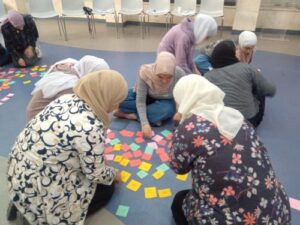
I divided the learners into teams to work on another group activity and distributed cards that I had prepared in advance. The learners arranged the cards according to priorities.
I prepared the learners and provided instructions, and I allocated a specific time for each part of the activity to ensure two different segments (Readiness Increase).
During the Activity Facilitation stage, I reminded them of the time in an engaging and motivating way. I also gave the learners full trust to manage the activity themselves. They distributed tasks among themselves according to each person’s energy level (Trust the Learner).
The activity was implemented in two parts. The learners discussed the learning outcomes during the Reviewing Actively stage (the third principle of the third domain – R Domain), and I elicited one of the key learning outcomes: determining priorities.
6 – Linking and Summarizing Activity – Red Light / Green Light
Applying the Sequencing within Learner eXperience Domain and two of its principles—particularly Linking and Summarizing and Repetition without Boredom—the activity began at a starting line where all key concepts were reviewed. The facilitator then explained the rules: learners advanced toward the “Green Light” upon hearing a correct answer or stopped at the “Red Light” when an answer was incorrect, with a prize awaiting the first learner to reach the finish line.
The game created a fun, engaging atmosphere that reinforced the Interacting within Positive Group Dynamics Domain and helped learners repeat key concepts in a different way. By linking, organizing, and sequencing the concepts together, all learners experienced a strong sense of achievement. Ultimately, this helped them clarify their goals, missions, schedules, and priorities, leaving the session equipped with a fresh perspective on time management.
7 – The Mission Activity
A printed template was prepared that included the hours of the day along with prayer times, monthly goals, a section for priorities, and a section for daily activities. It was distributed to all learners.
A follow-up was proposed after a period of time through visits to my office. Some activities were re-explained afterward for those who had missed them.
8 – Absence of an Energizer
The variety between Learning Activities and eXperience Activities, in addition to respecting energy levels, supported the application of the Sequencing within Learner eXperience Domain.
If I were to change one thing in this journey, I would have added an Energizer after the second Learning Activity, as I realized its importance at that stage of the journey for boosting learners’ energy and giving their minds a break before continuing with the remaining learning activities.
Conclusion
For the learners, the journey progressed with a great deal of sequencing and flow, which they expressed at the end of the session. The journey started and ended at the predetermined time, and the activities were facilitated accurately while applying all domains and principles. This helped everyone apply and experience all activities themselves and left a deep impact on the learners’ hearts and minds, changing their thinking and helping them improve their lives.
At the end of the session, I received many highly positive comments. Some participants expressed that the journey was extremely beneficial, while others described it as enjoyable, important, and motivating for action.
By the grace of Allah, an Active Deep Learner eXperience was designed and facilitated—a fruitful experience for the learners with a deep impact, Allah willing. We ask Allah for positive, deep, sustainable, scalable, and accepted impact.